Utah's 2026 Wildfire Season and HB48: What Every Homebuyer Needs to Know About Insurance
Utah's 2026 Wildfire Season and HB48: What Every Homebuyer Needs to Know About Insurance
Right now, as I write this, the largest active wildfire in the entire United States is burning right here in southern Utah. Not California, not Oregon. Utah. It is called the Cottonwood Fire, and it has already torched more than 90,000 acres, destroyed a ski resort, and forced entire communities to evacuate in the middle of the night.
Here is the part nobody told you when you started shopping for a Utah home. There is a brand new state law that took effect this year that could decide whether the house you are about to buy is even insurable. I want to show you something the listing agent is not going to volunteer: the exact map insurance companies are now legally required to use, a map that just flagged roughly 60,000 Utah homes as high risk, and how to check in about 90 seconds whether the address you are considering is one of them. Because if you buy the wrong house in 2026, you are not just buying a fire risk. You might be buying a home you cannot insure, cannot refinance, and someday might not even be able to sell.
Why 2026 Is the Year Everything Changed
This is not a normal fire season, and the experts are using words I have never heard them use about Utah before. The winter of 2025 into 2026 was the warmest on record for the state of Utah, and it came with one of the lowest snowpacks the state has ever measured. Snowpack is the savings account that is supposed to keep our mountains and vegetation damp through the dry months, and this year that account was nearly empty by springtime. By March, when most years there is still snow on the benches, the fuels were already dry enough to burn. In southern Utah, the vegetation is the driest it has been in a century.
So what happened is exactly what you would expect. As of late June, Utah had already recorded over 300 wildfires this year, burning more than 50,000 acres, which rivals the entire total from all of last year, and we were not even into July. Officials are openly saying they are seeing fire behavior in June that they would normally only see in mid-July or August. The National Weather Service office in Salt Lake City issued a particularly dangerous situation red flag warning for southern Utah, and here is why that should stop you cold: it was the first time in that office's history they had ever issued one. Winds gusting 40 to 45 miles per hour, humidity dropping to 7 percent, conditions they described as the highest level on the scale, extreme. And this is not abstract. This season, three firefighters were killed near the Utah-Colorado state line. When the people who fight these fires for a living tell us this year is different, we should listen.
HB48: The Most Important Law You've Never Heard Of
In 2025, the Utah legislature passed a bill called House Bill 48. It went into full effect this year, and if you are buying a home in Utah, this is arguably the single most important thing to understand, more important than the school district, more important than the HOA. Here is what HB48 actually does in plain English.
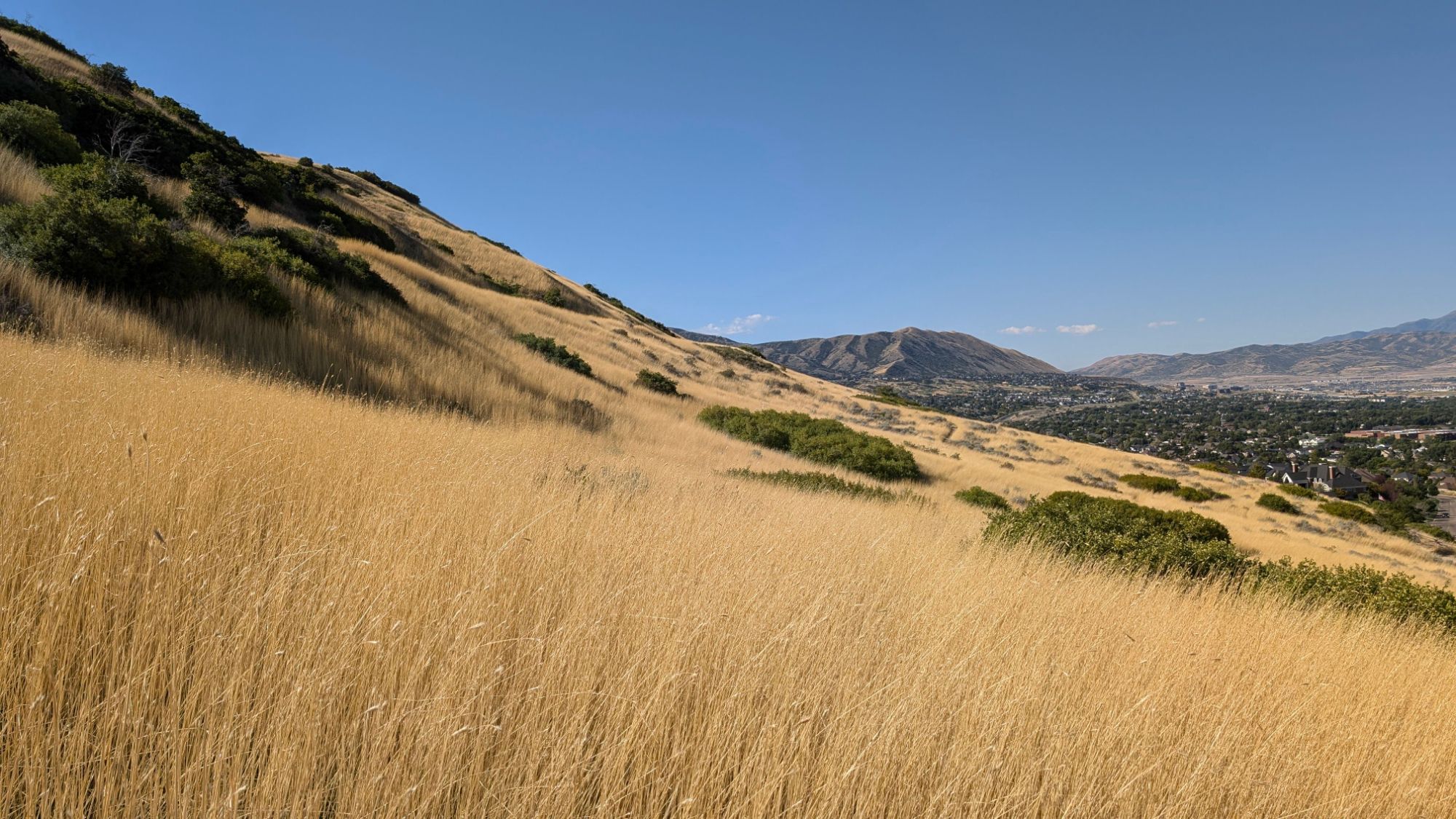
First, it created an official statewide wildfire risk map. For the first time, the state, through the Division of Forestry, Fire, and State Lands, drew hard boundaries around what they call the high-risk wildland urban interface, or WUI. The WUI is simply the place where neighborhoods bump up against undeveloped wildland: foothills, canyon mouths, and bench neighborhoods with that beautiful mountain view, the exact areas people moved to Utah for. When they finished drawing that map, roughly 60,000 structures landed inside the high-risk zone.
Second, and this is the big one, the law tells insurance companies that they must use the state's map. Before HB48, every insurer used their own private models and they all disagreed. Now every carrier operating in Utah has to reference the same standardized state boundary when they decide whether to insure your home and what to charge. One map, one source of truth, and your potential home is either inside that boundary or it is not. The law also added a consumer protection: if an insurer raises your rate by 20 percent or more, or cancels your policy because of wildfire risk, they now have to give you a written, factual justification if you ask for it. That is generally good for you as a buyer, but only if you know to ask.
Third, there is a new fee. If your structure is inside that high-risk boundary, you will see a wildfire mitigation fee on your property tax bill. For now, through 2026 and 2027, it is a flat fee somewhere between $20 and $100 per structure, based on the square footage of your taxable buildings. That sounds trivial, and on its own it is. But here is the detail that will bite people who are not paying attention. Starting in 2028, the flat fee gets replaced by something called a triage score, a property-specific rating based on how much wildfire risk your individual lot actually carries. And here is the trap: any property that has not completed a lot-level wildfire risk assessment automatically gets bumped to the highest risk tier. Read that again. If you buy a foothill home, do nothing, and ignore the assessment program, the state's default assumption in 2028 is that you are maximum risk, and that score is exactly what insurers will start leaning on. So the homework you do, or do not do, over the next couple of years directly sets your cost of ownership for as long as you hold that property.
The 90-Second Check Every Buyer Should Do
Before you write an offer on any Utah home, and I mean before you even fall in love with it, do this one check. It is free, it is public, and it takes about 90 seconds. Go to the Utah wildfire risk assessment portal at wildfirerisk.utah.gov. There is also a state resource at ffsl.utah.gov. Type in the property address, and the map tells you whether that structure falls inside the high-risk WUI boundary, the exact same one insurance companies are now required to use.
Now I have to flag something that trips people up, because the state actually maintains two related but different layers, and confusing them will cost you. There is the broad WUI zone, an area the county or city maps out to cover current and future development and enforce building codes. And there is the tighter high-risk WUI properties map, the structure-level map the state created to flag the highest-risk existing homes. That second one, the high-risk properties map, is the one insurers use and where the fee gets assessed. So when you check a property, you care most about whether the structure itself is flagged high-risk.
Here is how to read the result like a pro. If the home is not in the high-risk zone, for example a lot of the valley-floor communities and master-planned developments built on flat ground well away from the foothills, you can breathe easy. As one widely discussed example, and a neighborhood where I lived for 12 years, the Daybreak community in South Jordan sits on the valley floor away from the interface and is not among the flagged structures. Homes like that are not carrying the new mitigation fee and generally have a much smoother insurance picture. If the home is flagged high-risk, which will include a lot of the gorgeous bench and canyon neighborhoods up and down the Wasatch Front plus a big chunk of Washington County in southern Utah, do not panic and do not automatically walk away. It just means you now have three follow-up questions to answer before you go any further.
What's Really Happening With Insurance
This is the section that matters most, because a house you cannot insure is a house you cannot finance. No mortgage lender on earth will close without proof of insurance. So let us talk about what is really happening in the Utah market right now, not the scary headlines, the actual mechanics.
Utah was for years considered a low-risk insurance state, affordable, with an average homeowners premium sitting somewhere around $1,100 to $1,200 per year, below the national average. That is the Utah people remember. But Utah is changing fast, specifically in the high-risk zones. In the flagged areas, admitted standard carriers are increasingly declining new policies or non-renewing existing ones. A small handful of carriers are still writing coverage there, but they are doing it in one of two ways, and sometimes that means writing the policy with wildfire damage specifically excluded.
Underline that second one, because it is the sneakiest trap for a new buyer. You can get handed a policy that looks complete, your lender accepts it, you close and move in, and then you discover the one peril you actually needed covered, wildfire, was carved out. You are paying for insurance that will not pay for the fire. So when you read a quote in a high-risk zone, your job is to confirm in writing that wildfire is included, and to check whether there is a separate, higher wildfire deductible.
Why is this happening? It is not random and it is not your fault as a buyer. It is being driven by the reinsurance market, the insurance that insurance companies buy. The reinsurers have set hard rules based on wildfire scoring, and that pushes the standard carriers to decline the worst-scored properties. The state's own insurance commissioner has been very public about the goal: keep the private market in Utah and avoid the spiral that played out in California, where carriers fled and homeowners got stranded. And here is the part that should give you hope, because it puts real control back in your hands. That triage score cuts both ways. Homeowners who proactively reduce their risk with defensible space, fire-resistant siding, ember-resistant vents, and the right roof can qualify for a lower fee and, more importantly, can hand insurers documentation showing reduced risk. The state's own guidance is explicit that completing an assessment and lowering your triage score gives you official paperwork to argue for more favorable treatment on your premiums, and some carriers nationally already offer wildfire mitigation discounts for hardened homes. So the difference between an uninsurable foothill home and a perfectly insurable one is often not the location. It is what the owner did with the property. That is leverage, and as a buyer, it is leverage you can use at the negotiation table.
The Buyer's Playbook: Turning Risk Into Leverage
Most buyers hear wildfire risk and run. I want you to think differently, because a high-risk designation you understand better than the seller does is a negotiating tool. Here is the playbook.
Step one: make insurance a written contingency. Before you remove contingencies, get an actual bindable insurance quote on the specific property, not a ballpark, a real quote with wildfire coverage confirmed as included. If you cannot get coverage or the price is wild, you want to find that out while you can still walk away with your earnest money. Build this into your offer.
Step two: get the triage and assessment status. Ask whether the property has had a certified lot-level wildfire assessment and what its status is. The state's certified assessment program, the one that can actually lower the score insurers look at, has to be done by a state-certified assessor. A general inspection or a city visit from years ago does not count. If the home has not been assessed, that is not a dealbreaker, it is a to-do item and a price lever.
Step three: price the mitigation, then negotiate it. If the home needs work to harden it, a new Class A fire-rated roof, ember-resistant vents, clearing vegetation in the defensible space zone, or fire-resistant siding, get rough numbers on that work and bring them to the seller. In a market where high-risk homes are getting harder to sell, a documented list of required mitigation is a legitimate reason to ask for a price reduction or a seller credit. You are not being difficult, you are being correct, and you have the state map to back you up.
Step four: factor the true cost of ownership. Do not just look at the sticker price and the mortgage. Add the annual mitigation fee, the higher insurance premium, and the cost of defensible space maintenance every single year. Remember, assessments last about five years, and the risk comes back if you stop maintaining. That total is your real monthly number. Often it still pencils out beautifully for that view in that home. Sometimes it does not. The point is that you decide with your eyes wide open.
Step five: think about the exit before you enter. This is the one nobody does. Ask yourself: in five or ten years when you want to sell, will this home be easier or harder to insure than it is today? Properties in high-risk zones face rising premiums, possible non-renewals, and new fees, and over time that added cost can soften buyer demand and weigh on resale value. A home you hardened, documented, and kept a low triage score on is a home the next buyer can insure. That is not just safety, that is protecting your equity and your investment. The exact same designation that scares off the uninformed buyer becomes, for the informed buyer, a discount, a maintenance plan, and a resale strategy.
Home Hardening and Defensible Space Checklist
Let us say you have done the check, the home is in a high-risk zone, the view is worth it, and the numbers work. Now let us make sure you buy smart. Here is the checklist that lowers your triage score, helps your insurance, and gives your home a fighting chance when embers come. I will give these in the order that matters most.
The roof and vents come first. In an ember storm, and that is how most homes actually ignite, from wind-blown embers rather than a wall of flame, your roof and vents are the front line. A Class A fire-rated roof and ember-resistant vent screening are the highest-leverage upgrades you can make. If you are buying, ask what the roof is rated during the inspection.
The zero-to-five-foot zone. The five feet immediately around your foundation should be the most defensible space on the property: non-combustible materials right against the house, like gravel, stone, or bare soil, not bark mulch, not shrubs pressed against the wall, not a wooden deck packed with firewood underneath.
The five-to-thirty-foot zone. This is where you create spacing that breaks up the continuous fuel so a fire cannot run straight to the structure: space between trees and shrubs, mowed grass, and nothing that creates a ladder for flames to climb from the ground into the tree canopy and from the canopy onto your home.
Siding and the small openings. Fire-resistant siding matters, but so do the tiny gaps people never think about: under the eaves, the dryer vent, and the space under the garage door. Embers are opportunists and they find these openings.
And the part that is not a one-time purchase: maintenance. A defensible space you created three years ago and never touched again is not defensible anymore. Assessments are valid for around five years precisely because conditions return. Clear the gutters, rake the needles, and trim the branches every single season. This is the ongoing cost of the view, and you should make peace with it before you sign, not after.
One housekeeping note: if you already own in a high-risk zone, the state's guidance is that the new map generally should not blow up your existing policy midterm. Most changes, if they come, show up at your next renewal. So this is a review-your-coverage-now situation, not a panic-today situation.
The Bottom Line
Here is the encouraging truth underneath all of this. Utah's 2026 wildfire season is, by every measure the experts have, one of the most extreme the state has ever seen: record warmth, record-low snowpack, the largest fire in the country burning in our own backyard, and warnings the offices issuing them have never had to issue before. But the story for you, the buyer, is not really about the smoke. It is about the system now wrapped around that risk: a state map that flags 60,000 homes, an insurance market tightening in the high-risk zones, a new fee, and a triage score coming in 2028 that rewards the prepared and penalizes the passive.
None of this should scare you out of buying a home in Utah. It should make you the most informed buyer in the room. At the individual home level, wildfire is one of the most manageable major risks you will ever take on as a homeowner. You cannot control an earthquake or move a flood plain, but you can absolutely change the odds for a single house with a weekend of work and a maintenance habit. Run the 90-second check, make insurance a written contingency, price the mitigation and negotiate it, harden the home and keep it hardened. Do those things, and a high-risk designation becomes a discount and a strategy instead of a trap.
Thinking About Moving to Utah? Let's Talk.
Utah is one of the fastest-growing states in the entire country, and navigating the cultural landscape alongside the real estate market takes genuine local expertise. Whether you're considering Salt Lake County, Utah County, Davis County, or further out — finding the right neighborhood for your lifestyle, budget, and long-term goals makes all the difference.
My team and I work exclusively with buyers and sellers navigating the Utah real estate market. We help you cut through the noise, match the right submarket to your specific lifestyle and priorities, and make sure you're buying from a position of clarity — not FOMO.
Book a call with us HERE — free 30-minute consultation
Check out our relocation guide HERE
Subscribe to our weekly newsletter HERE
Scott Steele | HOME@TheUtahReel.com | 801-680-8050 | www.TheUtahReel.com
Categories
Recent Posts