The 5 Utah Cities Set to Explode Before the 2034 Winter Olympics
The 5 Utah Cities Set to Explode Before the 2034 Winter Olympics
On July 24th, 2024, in a conference room in Paris, 95 people raised their hands and quietly changed the future of Utah. That was the day the International Olympic Committee officially awarded the 2034 Winter Games to Utah — and the moment they did, a clock started ticking.
Here's what most of the headlines missed: the Olympics aren't just 16 days of skiing and ice skating in February of 2034. They're a deadline. They're the political and financial reason that billions of dollars in roads, rail, housing, and infrastructure are about to get unlocked across the state. And most of that money is not going where you'd assume — it's not all flowing into Salt Lake City.
If you're thinking about moving to Utah, buying, or investing here, these are the five cities I'd watch most closely, along with the approved, funded, already-under-construction projects behind each one.
Why the Olympics Are the Real Growth Engine
Before I name a single city, you need to understand the engine driving all of this. Go back to 2002, the last time Utah hosted the Winter Olympics. Ask anyone who lived here then what the Games actually left behind and they won't talk about the medals. They'll talk about the airport expansion, the TRAX light rail lines that didn't exist before, and the freeway upgrades. Projects stuck on a wish list for decades suddenly had a hard deadline and a global spotlight forcing them to happen.
The same pattern is repeating — except this time Utah is a fundamentally different state. In 2002, Utah had a little over 2 million people. Today the Kem C. Gardner Policy Institute at the University of Utah estimates the state's population at over 3.5 million as of July 2025. That's roughly a million and a half more people competing for the same roads, the same water, and the same housing.
The state knows it. A business community initiative called Utah Rising is openly framing the 2034 Olympics as the forcing function to fix housing affordability, expand the FrontRunner commuter rail, and build out transportation before the world arrives. So when I tell you a city is going to explode, I'm not guessing on vibes — I'm following the freeway dollars, the master development agreements, and the population numbers.
1. Saratoga Springs: Utah's Fastest-Growing City
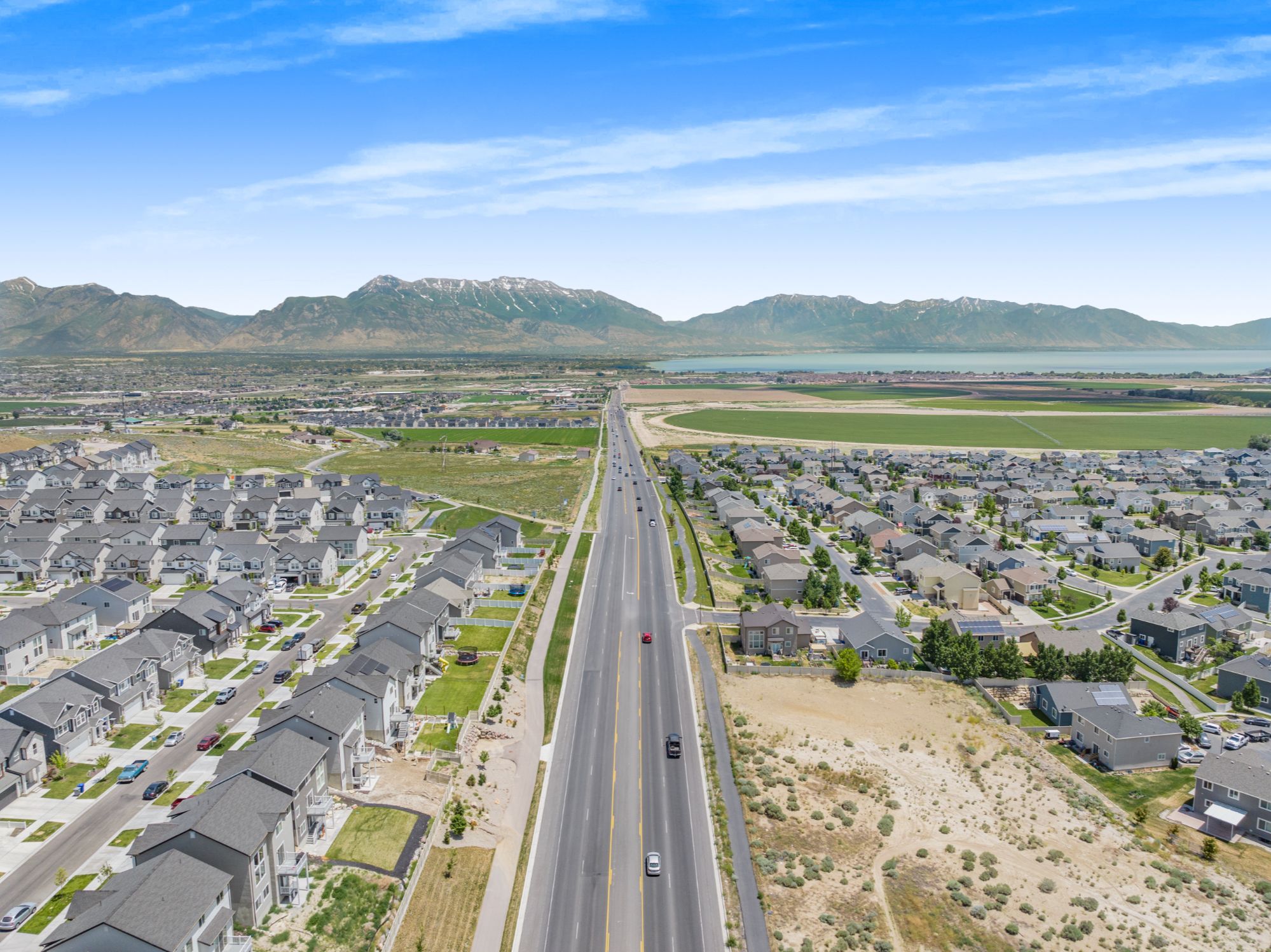
Let's start with the single fastest-growing city in the entire state. If you've been in Utah a while, you remember when Saratoga Springs was basically nothing. It only incorporated in December of 1997, back when the west side of Utah Lake was empty land and a few scattered homes. Now more than 70,000 people call it home.
Here's the number that should stop you cold: between July 2024 and July 2025, Saratoga Springs added an estimated 4,682 new residents in a single year. That's an 8.4% jump in 12 months and the largest raw population gain of any city in Utah. There are entire towns in this state that don't have 4,600 people total.
And it's not slowing down. The city's own projections suggest it could reach 120,000 residents at full buildout, and the broader Saratoga Springs, Eagle Mountain, and Lehi corridor is expected to blow past 500,000 people. The city's development tracker reads like a phone book of approved subdivisions — master-planned communities like Wander, a 350-acre Oakwood Homes development on the north shore of Utah Lake projected to deliver more than 1,600 homes, plus Wildflower, Beacon Point, and plat after plat approved through early 2026. A 117-acre commercial development was approved at State Route 73 and the Mountain View Corridor.
Now here's the Olympic connection: the road money. The Utah Department of Transportation approved nearly $1.4 billion in freeway projects for this corner of Utah County, including a $553 million extension of the Mountain View Corridor freeway south toward State Route 73. All of this sits at the point of the mountain, the choke point where Utah County traffic squeezes into Salt Lake County, and exactly where Olympic crowds, athletes, and media will be moving in 2034. The state can't afford that corridor to be a parking lot, so the money is flowing in now.
2. Eagle Mountain: Explosive Growth Plus a Secret Weapon
Right next door is Saratoga Springs' twin sister, and on a percentage basis it may be growing even faster. Eagle Mountain added roughly 4,169 residents between 2024 and 2025 — a 6.8% jump in 12 months — pushing it past 65,000 people. The Census Bureau named it Utah's fastest-growing city for 2025, with a growth rate that ranked ninth in the entire nation among cities of at least 20,000 residents. Combined, Saratoga Springs and Eagle Mountain now hold more than 125,000 residents, and both still have enormous amounts of raw, undeveloped land.
But here's the secret weapon: Eagle Mountain isn't just a bedroom community. It's quietly becoming one of the most important data-infrastructure locations in the Mountain West, with major tech and data investment flowing toward the Cedar Valley. Where data centers go, jobs, tax base, and higher-end residential development tend to follow.
Then there's the education play almost nobody outside the area has noticed. In May of 2026, the brand-new Lake Mountain School District, created after voters split the old Alpine School District, made a $19.7 million land deal for a 100-acre site. This is planned as a joint education campus combining a high school with Utah Valley University and Mountainland Technical College facilities. Analysts who track Utah money estimate that at full buildout it could eventually run into the $400 million to $700 million range. That's the kind of anchor that turns a suburb into a self-sustaining city, a direct pipeline from high school to college to the workforce. Add the freeway construction running through the area, and you can see why Eagle Mountain is number two.
3. Lehi: The Economic Engine of Silicon Slopes
If Saratoga Springs and Eagle Mountain are where people sleep, Lehi is where the region works. You've heard the term Silicon Slopes — Lehi is the heart of it, home to major tech players like Adobe, Oracle, and Microsoft with campuses just minutes apart. There are now over a thousand companies in the Silicon Slopes ecosystem, and Lehi is the gravitational center.
Why does that matter for an Olympics list? The Games don't just need venues; they need a regional economy strong enough to absorb billions in investment and to keep the world's attention after the closing ceremonies. Salt Lake City brings the venues and the history; Lehi brings the jobs and the money. Remember that nearly $1.4 billion UDOT freeway package? Lehi is right at the center of it, including a project worth over $500 million to convert 2100 North into a freeway connection between the new Mountain View Corridor freeway and I-15, improving east-west movement at the most congested seam in the state.
Here's the part most people miss: UDOT's own leadership has said that over the next 25 years, Utah County is projected to grow faster than Salt Lake, Davis, and Weber counties combined. Lehi sits at the front door of all of it. The city already went from orchards and farmland to a tech hub in about 15 years. What's happening now is the second wave, with infrastructure finally catching up to the jobs that are already here, accelerated by an Olympic clock.
4. Draper and the Point of the Mountain
Lehi shares a border with maybe the single most ambitious development project in Utah history, and it's being built on the site of an old prison. For decades the Utah State Prison sat on a massive piece of state-owned land in Draper, right on the line between Salt Lake and Utah counties. The prison was relocated, and those 600-plus acres in one of the most central locations on the entire Wasatch Front became available for redevelopment.
The result is a project simply called The Point, which the people building it have described as potentially the most significant development project in the history of the state. This isn't a subdivision, it's essentially a brand-new city inside Draper. The master plan calls for an innovation hub in the heart of Silicon Slopes, a walkable new downtown with local business and entertainment, housing across a range of price points (mostly rentals), and robust public transit and trails, the kind of design where you could live there and barely need a car.
Why does Draper belong on an Olympics list specifically? Location and timing. The Point sits at the exact geographic center between the two largest labor pools in the fastest-growing state in the country, the seam everyone passes through. Every dollar spent fixing point-of-the-mountain traffic directly raises the value of this land. And dirt is already moving: crews have been installing gas lines, roads, water lines, and parks for phase one right now, on a buildout timeline that runs straight through the Olympic window. Next door at the Lehi and Draper line, a second major mixed-use development called Point Crossing is rising out of a former gravel pit, with hundreds of homes, town homes, and commercial and office space tied into future transit.
5. Vineyard: From 139 People to a Real Skyline
I saved this one for last on purpose, because the story is almost hard to believe. In the year 2010, Vineyard had 139 people living in it. It was a rounding error on the map, sitting on the contaminated, idle site of the old Geneva Steel mill that had shut down in 2002. Then they cleaned up the steel site and the floodgates opened.
By the 2020 census, Vineyard had over 12,500 residents, making it — on a percentage basis — the fastest-growing city in the entire United States. Today it's home to roughly 17,000 people, still growing at nearly 5% per year, with a median age of around 25, one of the youngest cities in one of the youngest states in America.
But the population isn't even the real story. It's what they're building on that old steel site: a 700-acre master-planned downtown called Utah City, built around the Vineyard FrontRunner train station. We're talking about roughly 3 million square feet of commercial and office space, over 50 acres of public parks and open space, and hundreds of residential units, all designed as a walkable, transit-oriented urban core that is genuinely rare in Utah. And then there's the anchor that changes everything: in 2025 the Huntsman Cancer Institute broke ground on a new 272,000-square-foot hospital inside Utah City, with a comprehensive cancer center set to open to patients in the fall of 2028. That's a permanent, high-paying, high-prestige economic anchor, and it's all built around the exact FrontRunner line the Utah Rising initiative wants to expand for the Olympics. By 2034, Vineyard won't look like a suburb. It'll look like a small city with a real skyline.
The Bigger Picture: Utah's Center of Gravity Is Shifting
Zoom back out and look at the five: Saratoga Springs, Eagle Mountain, Lehi, Draper, and Vineyard. Notice the pattern — four of the five are in Utah County, not Salt Lake County. The center of gravity in this state is shifting south and west, away from where everyone assumes the Olympic action will be. It's telling that the Games even rebranded from "Salt Lake City 2034" to simply "Utah 2034" in late 2025 to reflect that the whole state is hosting.
The through line connecting all five is infrastructure on an Olympic deadline: nearly $1.4 billion in freeway projects, FrontRunner expansion, a potential half-billion-dollar education campus, a 600-acre downtown on a former prison site, a 700-acre downtown on a former steel mill, and a cancer hospital opening in 2028. None of these are predictions — every one is already approved, already funded, and already under construction. The Olympics didn't create Utah's growth, but the 2034 deadline is the accelerant poured onto a fire that was already burning. Whether you're deciding where to buy, where to invest, or where to plant roots, these are the five names to watch.
Thinking About Moving to Utah? Let's Talk.
Utah is one of the fastest-growing states in the entire country, and navigating the cultural landscape alongside the real estate market takes genuine local expertise. Whether you're considering Salt Lake County, Utah County, Davis County, or further out — finding the right neighborhood for your lifestyle, budget, and long-term goals makes all the difference.
My team and I work exclusively with buyers and sellers navigating the Utah real estate market. We help you cut through the noise, match the right submarket to your specific lifestyle and priorities, and make sure you're buying from a position of clarity — not FOMO.
Book a call with us HERE — free 30-minute consultation
Check out our relocation guide HERE
Subscribe to our weekly newsletter HERE
Scott Steele | HOME@TheUtahReel.com | 801-680-8050 | www.TheUtahReel.com
Categories
Recent Posts